 転妻つくし


Choosing between a hoikuen (保育園, nursery school) and a yochien (幼稚園, kindergarten) in Japan can be confusing, especially if you’re new to the country or moving to a new city.
Both offer early childhood care and education, but their schedules, enrollment requirements, and holiday arrangements can be very different. Hoikuen generally offers longer childcare hours, while yochien often follows a school-style schedule with longer holidays. However, some kindergartens offer extended care for working parents.
I experienced both firsthand. When my husband was transferred to another city in Japan, I left my job and moved our two children from private daycare to a traditional kindergarten.
The biggest surprise wasn’t the change in teaching style. It was how much the school schedule changed our daily lives.
In this guide, I’ll compare hoikuen and yochien based on their schedules, costs, parental responsibilities, and everyday routines. I’ll also share what I learned from switching schools, so you can make a more informed decision for your own family.
1. Our Experience: Switching from Hoikuen to Yochien After Moving
Both of my children had been in private daycare since they were 1 and 3 years old. A year ago, due to my husband’s job transfer, we moved to an unfamiliar town. Since I had also left my job as a short-term regular employee around the same time, we enrolled them in a kindergarten at our new location.
We went from a laid-back, play-based daycare to a more traditional, structured kindergarten. While there was plenty of culture shock between the two, I’d like to share what I’ve learned from experiencing both worlds.
2. Parental Burden: What Changed After the Transfer?

One of the biggest differences between daycare and kindergarten is the burden placed on parents.
While some modern kindergartens offer nursery-school-like extended hours, our children attended a traditional kindergarten where pick-up was at 3:00 PM with no extended care. Here is a quick comparison based on our experience:
| Feature | Daycare (Hoikuen) | Kindergarten (Yochien) |
| Operating Hours | 7:30 AM – 7:00 PM | 9:00 AM – 3:00 PM (No extended or long-vacation care) |
| Closed Days | Sundays, holidays, New Year | Weekends, spring/summer/winter breaks, plus many extra closures/half-days before events |
| Lunch | Provided daily (bento once a month) | Hot lunch 3 days/week, bento 2 days/week |
| School Events | Sports days mostly on Saturdays | Sports days on Saturdays, but recitals and observations are on weekdays |
| PTA | None | Yes, though duties have been scaled back |
The difference in operating hours is massive. The biggest shock for me after transferring was: “There are way too many school holidays!”
Long school breaks like summer vacation mean complete closures. Unless you have grandparents living nearby, working full-time while using this kind of kindergarten is extremely difficult. Even with a part-time job, I have to rely on working from home during long vacations.
If you are a working mom considering a switch to a traditional kindergarten, I strongly recommend checking the annual calendar and operating hours thoroughly in advance.
3. Is It Possible to Balance Work and Kindergarten?
Can you balance work after moving to a kindergarten? It depends entirely on the school!
If a kindergarten lacks extended childcare or holiday care, it makes life very tough for working mothers. Summer break lasts a whole month, and trying to work while entertaining young children at home is a huge challenge. If you don’t have local support, choosing a kindergarten with robust extended care is safer.
4. Looking Back: The Pros and Cons of Daycare
Pros:
- Long operating hours
- Minimal burden on parents
- Daily nutritious hot lunches and snacks
- Easy daily communication with teachers inside the classroom
- Higher teacher-to-student ratios than kindergartens
- Safe environment to play with friends until evening
Cons:
- Catching frequent illnesses (especially at ages 1 and 2)
- Strict rules for attending school when sick
- Preparing nap futons and lots of changes of clothes
- Occasional guilt about leaving kids until late
5. Looking Back: The Pros and Cons of Kindergarten
Pros:
- Fun events and class observations for parents
- Early exposure to letters and numbers, making elementary school prep smooth
- More opportunities to make mom friends
- Free time after 3 PM for hobbies or rest
- Uniforms make mornings much easier
Cons:
- Too many holidays and school closures
- No daytime nap (can lead to overtired, grumpy afternoons for younger kids)
- Weekday events can be hard for working parents
- Harder to casually talk to teachers
- Higher overall costs (uniforms, event fees, snack costs, etc.)
6. Were the Kids Okay with the Transfer?
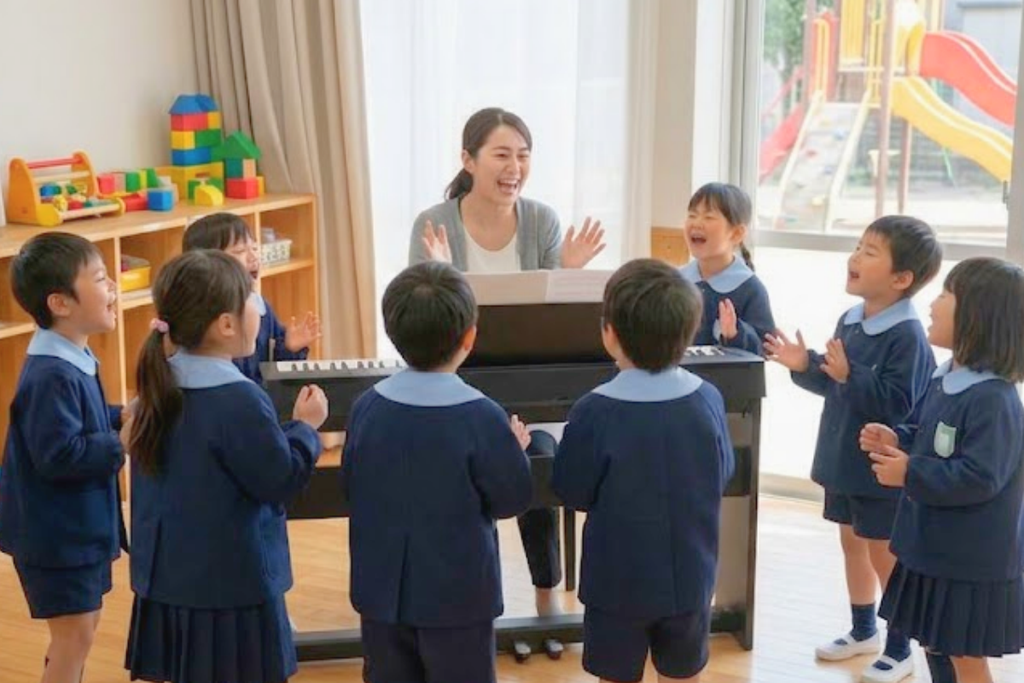
Will children be okay switching from daycare to kindergarten? The conclusion is: They were totally fine!
While I was worried at first, kids have incredible adaptability. They quickly made new friends and adjusted to the new routine. If anything, I was the one who needed more time to get used to the quicker afternoon schedule and sibling squabbles at home!
7. Conclusion: Which is Better?
Having experienced both, my conclusion is: As long as you like the school’s philosophy, either is fine!
Whether it’s daycare or kindergarten, the most important thing is whether the school’s style and teachers match your child and align with your values as a parent. If you plan to work, just make sure to double-check the childcare hours and schedule beforehand so you don’t stretch yourself too thin!